Local
- Notes from
- Resources
- How to run a local coding agent with Gemma 4 and Pi
- Step-by-step tutorial for setting up LM Studio and Pi
- Running local models is good now (Boykis)
- Runs LM Studio, Pi, and Gemma-4-12b-qat in a docker container with no access to run code or search the internet
- Gives Pi config, Docker Compose file, and bash script
- Use Models from the Hugging Face Hub in LM Studio
- Cost
- How Much Does It Actually Cost to Run a Local LLM? (Euros per Million Tokens, Measured)
- Measured GPU electricity for eight local models on one RTX 3090
- How Much Does a Local LLM Actually Cost to Run? I Measured Every Watt on Apple Silicon
- Five models, sustained generation, real wall-socket energy at $0.31/kWh
- How Much Does It Actually Cost to Run a Local LLM? (Euros per Million Tokens, Measured)
- How to run a local coding agent with Gemma 4 and Pi
- Components
- Local model inference engine - Runs/hosts LLM
- Agentic harness - Provides the environment, context, and tooling for agents to operate
- Local model artifact
- Gemma-4-12b-qat
- Companies are doing is tiered routing: about 70% local SLM, 20% mid-tier API, and 10% frontier API. (2026)
- The best 30B coder SLMs top out around 50% on SWE-bench Verified while Claude Opus 4.6 hits 80.8% on SWE-bench Verified (2026)
- Tradeoffs (2026)
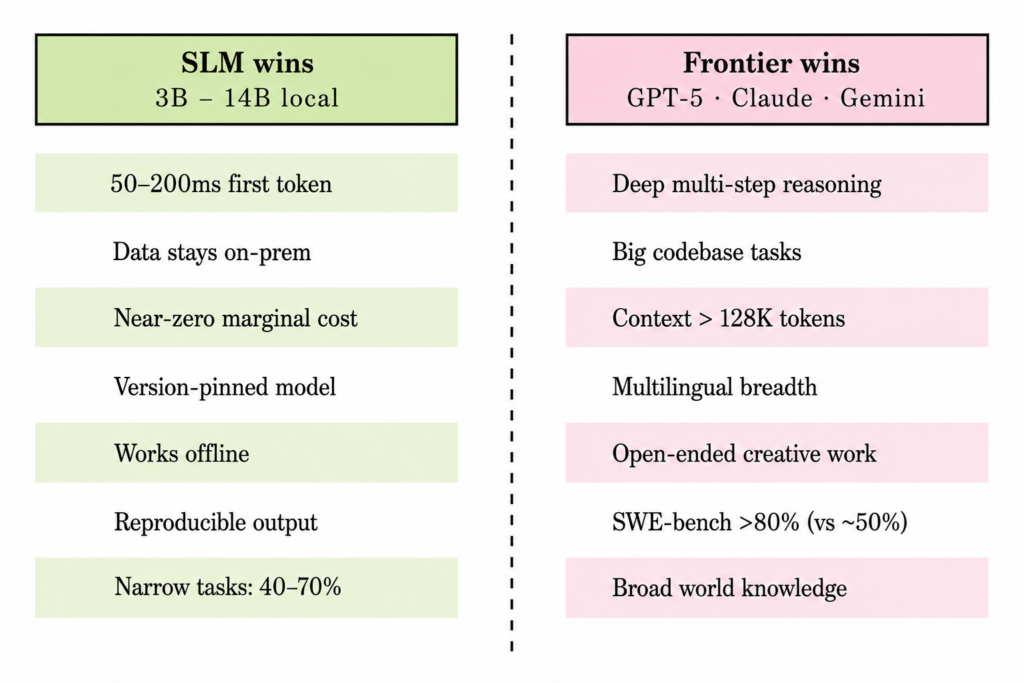
- A 3B to 8B local model is roughly a 2023-era GPT-3.5 for general chat: useful, not magical.
- Trusted Benchmarks
- GPQA Diamond
- SWE-bench Verified
- ARC-AGI-2
- HLE
- LiveCodeBench
- Models
- Qwen3.8-27B (source)
- Includes native image and video understanding, a 262,144-token context window, configurable reasoning and support for coding and agentic workflows
- Requirements
- 16-bit precision requires roughly 56GB of GPU memory
- FP8 version needs about 28GB of GPU memory
- 4-bit quantization cuts the model itself to roughly 17GB of GPU memory
- i.e. M5 Max MacBook Pro with Nvidia DGX Spark (Willison)
- Benchmarks
- 61.7 on SWE-bench Pro (Beats Claude Opus 4.6 Max)
- 90.3 on LiveCodeBench v6 (Beats Claude Opus 4.6 Max)
- 70.7 on its CoWorkBench office-work benchmark
- 84.3 on OSWorld-Verified
- 52 on Artificial Analysis’ Intelligence Index, a composite of nine evaluations spanning coding, science, reasoning and professional tasks (Equal to GPT-5.6 Luna Max)
- 51 Artificial Analysis’ Agentic Index measuring agentic task performance (Beats Claude Opus 4.8)
- Performance comes from thinking
- Artificial Analysis says the model generated 160 million output tokens across its Intelligence Index testing, versus a 43 million median for comparable open-weight models.
- Willison encountered an extreme version of the same behavior because Qwen defaults to its xhigh reasoning setting. A request to generate an SVG of a pelican riding a bicycle took 21 minutes and consumed more than 22,000 reasoning tokens before producing the answer. He recommends starting with low or no reasoning for ordinary local use
- Qwen3.8-27B (source)
- Security Issues
- In February 2025, ReversingLabs found malicious models on Hugging Face using broken pickle files to smuggle a reverse shell past the scanner; they sat undetected for about eight months.
- Prompt injection works exactly the same against a local model
- RAG content can carry instructions
- Tools like Ollama and LM Studio ship without safety classifiers by default.
- Guidelines
- Ues SLMs when:
- The task is high-volume and narrow: classification, extraction, routing, summarization.
- Latency is critical: autocomplete or voice, where you need first-token times under 100 ms.
- You’re in a privacy-regulated domain: healthcare, legal, finance or government, where the data can’t leave the building.
- It’s an agentic sub-task, an edge or offline deployment, or any workload pushing past a few million tokens a day, where the API meter becomes the dominant cost.
- Good at summarization, rewriting, basic Q&A, code completion, and RAG over your own documents.
- Weak at deep reasoning, long multi-step problems, and niche factual recall.
- Use frontier models when:
- The work is open-ended or one-off: creative writing, research assistance, or debugging across a large codebase.
- You need broad world knowledge: complex multi-tool agents, or customer support across long-tail languages.
- The volume is low: under maybe 1,000 requests a day across varied tasks. Here the API is cheaper and better.
- Ues SLMs when:
- Memory
- A rule of thumb for fitting a model in memory at 4-bit: budget about 0.6 to 0.8 GB per billion parameters, plus 1 to 4 GB for context and overhead.
- Guidelines
- 8 GB RAM handles 1 to 3B models
- 16 GB runs a 7 to 8B comfortably
- 32 GB RAM handles 13 to 14B, or a 27 to 30B model, if you’re patient
- 24 GB GPU (e.g. RTX 4090) runs Gemma 3 27B (QAT) or Qwen3-30B-A3B well
- Response Speed
- Expect 10 to 40 tokens per second on a modern laptop
- Expect 80 to 150 on an RTX 4090
- Fine Tuning
- A small model with constrained decoding (Outlines, XGrammar) hits 99%+ schema validity, where a larger model drifts.
- Do when:
- The task is narrow and repetitive at scale. NVIDIA’s rule of thumb: a stable schema plus more than 10K requests a day.
- Latency or cost ceilings bind, privacy requires on-prem, or you need behavioral reliability.
- Prompt a frontier model instead when:
- The task is open-ended, evolving, or low-volume, or it needs broad world knowledge.
- The knowledge changes: RAG beats fine-tuning anyway.
- QLoRA is the default: a 4-bit NF4 base with BF16 LoRA adapters.
- Rank: start at 16, raise to 32-64 for harder tasks.
- Alpha: 32
- Learning rate: ~2e-4 for supervised fine-tuning, 5e-6 for DPO
- Epochs: 1 to 3 (more usually overfits)
- Train in the precision you serve in.
- Data Requirements
- Style and format adaptation (100 to 1,000 pairs): Teaching a model to respond in a specific tone, length, or structural format (like JSON).
- Classification or extraction (1K to 10K examples): Training a small model to consistently map text to specific categories or pull structured entities out of raw text.
- Injecting domain knowledge (10K to 100K): Trying to teach the model new facts.
- If you need this much data, RAG (Retrieval-Augmented Generation) is usually a better and more reliable choice than fine-tuning.
- Reasoning distillation (100K to 1M+ traces): Teaching a smaller model complex multi-step reasoning by training it on the thought processes (chains of thought) generated by a much larger frontier model.
- Evaluation before you train
- Build a task-specific eval set of 100 to 500 hand-graded examples before you train.
- Track schema validity, exact-match, executable-call rate, p95 latency, and cost per successful task.
- Tools like lm-eval-harness, promptfoo, and Arize Phoenix handle the mechanics.
- Use an LLM-as-judge only after you’ve sanity-checked it against human grades.
- Guidelines
- If you’re running more than 10 requests per second on a single narrow task, fine-tune a 3 to 8B model and self-host it, as the volume justifies the upfront effort and the cost savings compound.
- If you’re under 100 requests a day across varied tasks, don’t bother: just call an API, since you’ll never recoup the time spent training and maintaining your own model.
- If you’re somewhere in the middle, start with prompting plus RAG, and only reach for fine-tuning once your evaluation set stops improving.
- Tools
- Examples
Example: Ollama
Pull model
ollama pull qwen3:4b
ollama run qwen3:4b
Point to code base
from openai import OpenAI
# Same SDK you'd use for the cloud, pointed at your local model
client = OpenAI(base_url="http://localhost:11434/v1", api_key="ollama")
resp = client.chat.completions.create(
    model="qwen3:4b",
    messages=[
        {"role": "user", "content": "Summarize this support ticket in 3 bullets: ..."}
    ],
)
print(resp.choices[0].message.content)
Example: Tiered Routing
# Toy router: handle narrow work locally, escalate to a frontier model # only when the task genuinely needs broad reasoning or long context. def answer(task): if task.kind in {"classify", "extract", "summarize", "route"}: return local_slm(task.text) # runs on your machine, ~free if task.tokens > 128_000 or task.kind == "open_ended": return frontier_api(task.text) # broad reasoning, long context return local_slm(task.text) # default to local, fall back if low confidence- In production, you’d also add a confidence check on the local answer and escalate on failure
Example: Fine Tuning
from unsloth import FastLanguageModel

model, tokenizer = FastLanguageModel.from_pretrained(
    model_name="unsloth/Qwen3-4B-Instruct",
    max_seq_length=4096,
    load_in_4bit=True,                # NF4 4-bit base
)

model = FastLanguageModel.get_peft_model(
    model,
    r=16, lora_alpha=32,              # bump to 32-64 for harder tasks
    target_modules=["q_proj", "k_proj", "v_proj", "o_proj",
                    "gate_proj", "up_proj", "down_proj"],
)

# Then train with TRL's SFTTrainer at lr=2e-4 for 1-3 epochs.